Building a Universe of Legendary Assassins
Some worlds are built around kingdoms. Others revolve around heroes.
Eclipse was built around shadows.
The project began with a simple creative challenge: How do you create a cast of assassins from different cultures, eras, and realities while making them feel like they belong to the same universe?
Rather than designing isolated character concepts, our goal was to establish a believable original intellectual property with a distinctive artistic identity. Every character needed to stand on their own while contributing to a larger narrative that players could instantly recognize.
Read more: EclipseThe result became Eclipse—a dark, cinematic universe where legendary assassins exist beyond the boundaries of history, each carrying their own story, philosophy, and deadly craft.


The Vision
Every memorable franchise has a visual language.
Before creating a single character, we established the creative pillars that would define Eclipse.
The world needed to feel mysterious, dangerous, elegant, and timeless. Every design would embrace darkness without becoming visually repetitive, allowing each assassin to remain unique while clearly belonging to the same universe.
Instead of relying on excessive ornamentation, we focused on powerful silhouettes, cinematic lighting, restrained color palettes, and subtle visual storytelling.
The objective wasn’t simply to create beautiful artwork.
It was to create a universe.
A Brotherhood Beyond Time
Unlike traditional worlds limited to one historical period, Eclipse brings together assassins from entirely different civilizations and realities.
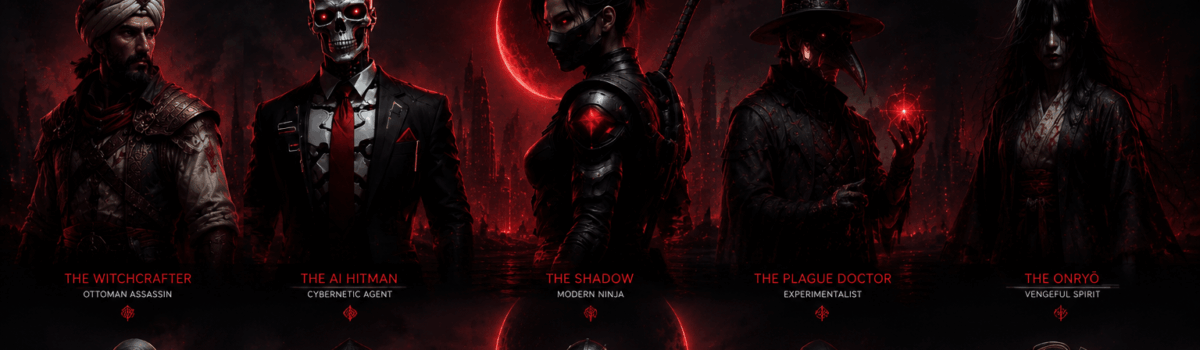
An Ottoman warrior empowered by forbidden rituals stands beside a cybernetic contract killer from the future. A wandering ronin shares the stage with an immortal spirit seeking vengeance. A plague doctor experimenting with dangerous alchemy exists alongside a modern tactical operative trained for covert warfare.
Every character originates from a different world, yet every one of them feels connected through a shared mythology.
That contrast became the heart of Eclipse.
Designing Distinct Personalities
Character design begins long before the first sketch.
Every assassin was developed around a central identity rather than simply a visual appearance.
Questions guided every design decision.
What drives them?
What do they fear?
How do they fight?
What sacrifices have shaped them?
How would someone recognize them from nothing more than their silhouette?
Answering those questions allowed every costume, weapon, posture, and expression to reinforce the personality behind the design.
The result is a roster where every character feels immediately recognizable without relying on names or dialogue.
Crafting a Unified Visual Language
One of the greatest challenges was balancing variety with consistency.
Although every assassin belongs to a different culture, we established several artistic principles that unify the entire collection.
A cinematic approach to lighting emphasizes dramatic contrast and atmosphere. Crimson energy serves as a recurring visual motif, symbolizing power, conflict, and the unseen force connecting every assassin. Dark materials, subtle environmental storytelling, and restrained color palettes create a cohesive identity without limiting creativity.
These elements ensure every illustration feels like part of the same world while allowing individual personalities to shine.
Storytelling Without Dialogue
Great concept art should communicate a narrative before a single word is spoken.
Every detail within Eclipse serves a purpose.
A worn cloak suggests years of survival.
A ceremonial blade hints at forgotten traditions.
Mechanical implants reveal a future where humanity has merged with technology.
Weathered armor speaks of countless battles fought in silence.
Rather than decorating characters with random details, each design decision supports a larger story waiting to be discovered.
This philosophy allows audiences to imagine entire histories simply by looking at a single image.
A Production-Ready Creative Pipeline
Eclipse was approached not as a collection of illustrations but as the foundation of a fully realized entertainment property.
Each character was developed with future production in mind, making the designs suitable for games, cinematic trailers, animation, graphic novels, marketing campaigns, collectibles, and expanded storytelling.
Throughout development, AI-assisted concept exploration accelerated early ideation, while artistic refinement, composition, and creative direction remained firmly driven by human expertise.
Technology became a catalyst for creativity rather than a substitute for it.
More Than Character Design
Eclipse showcases Patlix Studio’s ability to transform an idea into a cohesive intellectual property.
The project demonstrates expertise across multiple creative disciplines, including:
- Character Design
- Concept Art
- Art Direction
- World Building
- Costume Design
- Visual Storytelling
- Digital Illustration
- AI-Assisted Creative Pipelines
- Brand Identity Development
- Franchise Planning
Each discipline contributes to a unified vision capable of growing far beyond a single project.
Looking Toward the Future
The strongest fictional worlds leave audiences wanting to know more.
Who leads these assassins?
Why do they exist across different timelines?
What force binds them together?
Those unanswered questions are intentional. They invite curiosity, encourage imagination, and establish the foundation for future stories.
Eclipse is more than a portfolio piece—it is a proof of concept for how compelling intellectual property begins. It demonstrates how thoughtful world-building, memorable characters, and cohesive art direction can transform individual illustrations into the first chapter of something much larger.
At Patlix Studio, we don’t just design characters.
We create worlds with the potential to become games, films, animated series, and unforgettable franchises.
I would also make this feel like a real AAA case study by adding project metadata at the top:
- Client: Internal IP Development
- Industry: Video Games / Entertainment
- Services: Character Design, Concept Art, World Building, Art Direction, AI-Assisted Creative Pipeline
- Timeline: 3 Weeks
- Tools: Blender, Photoshop, Substance 3D, AI-Assisted Concepting, Unreal Engine (Visualization)
- Status: Original Intellectual Property (Concept Phase)